

By Mahdi Nouraie, Macquarie University
In the late 1990s, Sally Clark lost two children to sudden infant death syndrome. During her trial, a statistic became central to the prosecution’s argument.
The probability of a sudden infant death occurring in a family like hers was estimated as roughly 1 in 8,543.
Rare, but possible.
Then came the step that changed everything. The statistic for one death was multiplied by itself, as if having one child die this way made no difference to the chances of it happening again. This is the same basic math used to work out the odds of flipping two heads in a row: you multiply the probability of each separate event together.
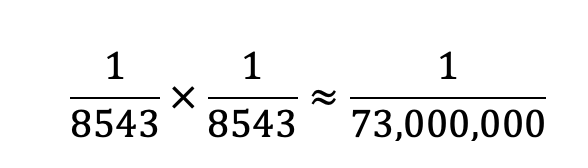
One in 73 million.
The number carried enormous rhetorical force. Numbers at that scale stop feeling like quantities and begin to feel like verdicts.
The implication seemed obvious: Events this unlikely do not happen naturally.
But the calculation quietly assumed the two deaths were independent events. In other words, it treated the first death as giving no information about the probability of the second. Medical researchers later argued this assumption was deeply questionable. Genetic and environmental factors shared within families can increase risk across multiple children.
The calculation itself was unsound: Treating the two deaths as independent was the wrong assumption to make. But even a corrected number would still answer the wrong question.
The courtroom had measured the probability of two deaths assuming innocence. But that is not the same as measuring the probability of innocence given two deaths. A rare event under one explanation does not automatically become evidence against it.
Sally Clark was convicted of murdering her children.
The case illustrates a common statistical error: treating an event’s rarity as evidence for one particular explanation. But a probability cannot tell us what happened unless we compare how well the evidence fits the possible explanations.
Years later, concern over the statistical reasoning was formally raised by the Royal Statistical Society, which stated the figure had no valid statistical basis. Her conviction was eventually overturned.
The number itself never changed. What changed was the story attached to it.
In Australia, Kathleen Folbigg’s case followed a different path. There was no devastating calculation. Only repetition.
Four children.
Four deaths.
One family.
No one multiplied probabilities in public. Repetition performed the arithmetic emotionally instead.
At some point, repeated tragedy can begin to feel incompatible with chance. Two events can still be called terrible luck. Four feels different. Four feels deliberate.
Kathleen Folbigg was convicted in 2003. The prosecution’s case did not rest on the deaths alone. Her diaries and other circumstantial evidence were central to it, but the repetition of loss still shaped how that evidence was read.
Years later, new genetic and medical evidence provided plausible natural explanations for the children’s deaths. A rare genetic variant offered a possible explanation for the deaths of Folbigg’s two daughters, while other genetic and medical evidence concerned her sons. Experts also reconsidered the diary entries that had been presented as evidence of guilt.
The inquiry did not uncover one cause behind all four deaths. Instead, it showed that the prosecution’s explanation was not the only one consistent with the evidence. Once other possibilities were considered, the pattern no longer pointed as clearly toward guilt.
The Question Nobody Asked
For years, the number in Sally Clark’s case looked devastating until statisticians asked a simple question: Compared with what?
The courtroom had evaluated one possibility: How unlikely are these deaths if they were natural? But courts do not decide between reality and impossibility. They decide between competing explanations.
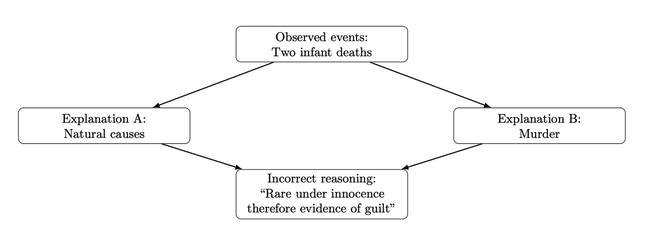
A rare event under one explanation does not automatically support an alternative explanation.
This distinction matters because probability runs in two directions. One approach begins with an explanation and asks what events would follow from it. The other begins with observed events and asks which explanation best accounts for them. Confusing these directions is surprisingly easy, especially when a number appears overwhelmingly small.
The 1-in-73-million figure estimated how unusual two natural infant deaths would be under a particular set of assumptions. It did not estimate the probability that Clark was innocent. To interpret the deaths as evidence, jurors needed to compare two questions: How likely were the deaths if they occurred naturally, and how likely were they if Clark had killed her children? A small number answering only the first question could not establish the second.
The calculation also assumed the deaths were independent, that the first child’s death did not change the probability of the second. That assumption did not account for genetic or environmental factors the children might have shared.
Confusing the probability of the evidence under innocence with the probability of innocence given the evidence is sometimes called the prosecutor’s fallacy.
Once comparison disappears, a number stops helping a decision and starts replacing it.
The Crime of Being Improbable
An unusual pattern may justify further investigation, but it cannot determine its own cause. Whenever a probability is presented as proof, three questions matter: What does the number actually measure? What assumptions produced it? How well does the evidence fit the competing explanations?
“This would be rare if the person were innocent” is not the same as “The person is probably guilty.” The difference is more than mathematical. In a courtroom, it can determine how evidence is understood and whether justice is done.
Further Reading
- 2022 Inquiry into the Convictions of Kathleen Folbigg, NSW Government (2022).

Leave a Reply