

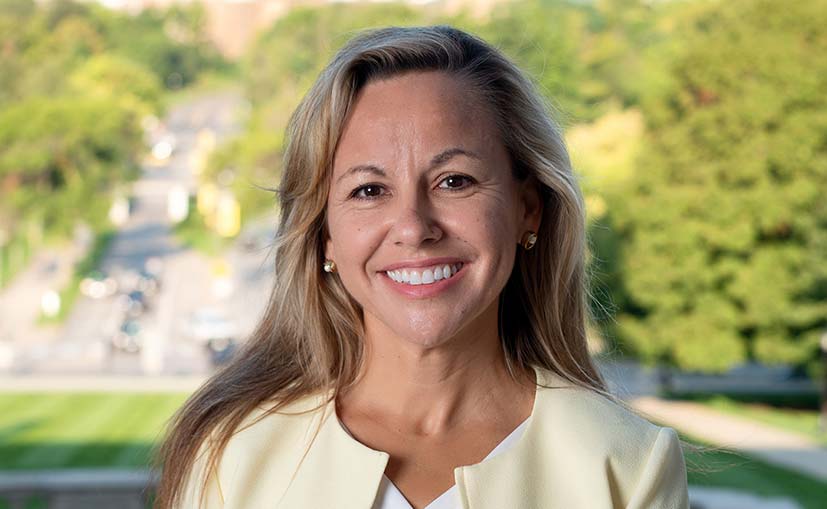
By Montserrat Fuentes
For most of my career, getting an answer took time. Statistical work meant understanding the question, finding the right data, thinking about how it had been collected, choosing or developing a model, writing code, checking the analysis, and then deciding what we could reasonably conclude. The computation mattered, but it was never the whole job. Often, the harder part was deciding how much confidence to place in what we had found and how to explain it to someone who needed to make a decision.
I have spent much of my professional life in that space between data and conclusion. My research has taken me from environmental and spatial statistics to health, neuroimaging, and—more recently—artificial intelligence. In all those areas, uncertainty is part of the problem from the beginning. My years as a dean, provost, and university president gave me another way to see the same issue. Universities are full of data, from enrollment and retention models to financial forecasts, student outcomes, surveys, and rankings. Yet the important decisions were rarely obvious simply because we had more numbers.
I remember many conversations in which a forecast or dashboard seemed to offer a clear direction until we looked more closely. An enrollment projection might show growth, but only if its assumptions were realistic. A model might identify students more likely to leave, but it could not tell us what would help them stay. A new academic program might look strong on a spreadsheet while depending on demand that had not been tested. The data informed the decision but never removed the need for judgment.
That experience shapes the way I think about artificial intelligence and the future of statistics. In conversations with doctoral students, postdocs, junior faculty, and colleagues, I increasingly hear concern about where the profession is going. Some worry about a tighter job market or wonder whether a PhD offers the same path it once did. Departments are thinking about how to attract strong students as choices in data science, computing, and AI expand. Now another question sits on top of those concerns: If AI can write code, fit models, summarize results, and produce an interpretation almost instantly, what will make a statistician valuable?
The statistician’s value is not simply in producing an answer. It is in understanding whether the answer deserves to be believed, what it leaves out, and what should happen next.
I think that is the right question, but I would answer it differently than I might have a few years ago. I do not see the future as a contest between statisticians and AI. I see a change in where the value of statistical work sits. As the mechanics of analysis become easier and faster, the parts of the work that require judgment become more important. The statistician’s value is not simply in producing an answer. It is in understanding whether the answer deserves to be believed, what it leaves out, and what should happen next.
When Fast Answers Demand Better Judgement
I have often thought of statistics as the science of uncertainty. We use data to learn about a world we can never observe completely, and our methods are built not only to estimate what may be true, but also to show how sure we are, what assumptions support a conclusion, and where the evidence stops. That way of thinking is central to our field. We ask whether the sample represents the population we care about, whether the design supports the conclusion, what information is missing, and whether a result that works in one setting is likely to hold somewhere else. More data does not repair biased data, and a precise estimate can still answer the wrong question.
None of this is new to statisticians. What is new is how quickly an answer can now appear and how convincing it can sound. A weak analysis does not necessarily look weak, and an uncertain conclusion may not sound uncertain. A model can be applied to a different population without making that limitation obvious. Any model can be wrong, and so can any statistician. The larger change is that polished answers can now be produced at a speed and scale we have never experienced before. That makes our habit of asking how much confidence an answer deserves more valuable, not less.
What the Labor Market Is Telling Us
The labor market is already giving us some clues. In the World Economic Forum’s The 2025 Future of Jobs Report, analytical thinking remained the most frequently identified core skill, cited by 69% of employers, even as AI and big data ranked among the fastest-growing areas of skill demand. The report also estimated that 39% of workers’ current skills are expected to change or become outdated by 2030. I read that as a reminder that knowing how to use a tool and knowing how to think with evidence are not the same thing.
Move Toward the Science
For people building research careers now, that distinction matters. Technical depth will remain essential. We still need statisticians who develop theory, methods, and better computation, and who understand the mathematics behind them. But I would no longer define depth only by how many techniques someone knows or how much code someone can write without assistance. AI will make parts of that knowledge easier to access. What will be harder to replace is understanding the full path from the question that motivated an analysis to the decision that may follow.
Some of the most important problems I have encountered in research did not begin with the model. They began earlier. The sample did not represent the population of interest. The outcome was measured differently across sites. Important information was missing. Data collected for one purpose was being asked to answer another question. Sometimes the most useful contribution was not a more complicated model but recognizing that the data could not support the conclusion we wanted to make. As models become easier to fit, that kind of judgment matters more, not less.
This is why I would encourage researchers to move toward the science, not away from it. A statistician working in health needs enough clinical understanding to know whether a result matters for patients. In environmental research, we need to understand the process that generated the measurements. The best collaborations I have seen are not those in which the statistician arrives at the end to analyze a finished data set. They are the ones in which the statistician helps shape the question, the design, the data collection, and the meaning of the result from the beginning.
The Statistical Questions AI Is Creating
I also see a rich research landscape ahead around validation, generalizability, and uncertainty. We can build models that perform remarkably well, but what happens when we take them somewhere else? A model developed in one hospital may behave differently in another. A prediction built from one population may not transfer to another. Relationships can change over time, and a system that once performed well may slowly become less reliable as the world around it changes. Understanding where a model works, where it stops working, and how quickly we can detect that change is not a side issue in AI. It is one of the central statistical problems AI is creating.
The same is true of uncertainty. A single prediction is rarely enough for an important decision. We need to understand how uncertain it is and what happens if it is wrong. My leadership experience made this especially clear because leaders rarely have the luxury of waiting until uncertainty disappears. Decisions about people, programs, budgets, and institutional direction must be made with incomplete information. Good analysis does not remove that reality. It helps us see more clearly what we know, what we do not know, and what assumptions we are making as we decide.
Communication Is Part of the Analysis
That experience also changed how I think about communication. Early in a statistical career, it is easy to see communication as something we do after the real analysis is finished. I now see it as part of the analysis itself. A technically correct result has limited value if the person making the decision does not understand what the evidence supports, where the uncertainty lies, which assumptions matter, and what new information could change the conclusion. A research collaborator, physician, board member, or university leader does not need every mathematical detail, but they do need an honest account of what the analysis means and what it does not mean.
For doctoral students, postdocs, and researchers establishing an independent program, I think this opens a more hopeful path than trying to stay one technical step ahead of AI. The tools will change too quickly for that to be a lasting strategy. Learn to use them well and let them help with coding, exploration, and routine computation. But invest deeply in study design, measurement, data quality, bias, generalizability, uncertainty, and the science behind the data. Learn not only how models work, but how they fail, and how to recognize when a result is technically impressive but practically unhelpful.
I would also resist the idea that the future belongs only to people working directly on AI methods. AI is creating statistical questions across almost every field, including how models transfer across populations, how performance changes, how uncertainty should be represented, and how human judgment should work with automated recommendations. These are new settings for some of the oldest concerns in statistics, with plenty of room for original work.
Do not measure your future only by the tasks AI may be able to perform. Look instead at the questions that become more important because AI can perform them.
Looking back across my career in research and institutional leadership, I have become convinced that the most consequential decisions rarely depend on who has the largest data set or the most elaborate model. They depend on whether we understand what the evidence can support, what remains uncertain, and what may happen if our assumptions are wrong. That is why I am more optimistic about the future of statistics than the anxiety around AI might suggest.
We are entering a period in which answers will be abundant. Models will be easier to build, code easier to generate, and analyses that once took days may take minutes. Our training will need to change with that, but it can also free statisticians to spend more time choosing good questions, understanding the data, testing whether results hold, measuring uncertainty, and helping others make sound decisions from incomplete evidence.
For those deciding what to study, what research problems to pursue, or how to build a career in statistics now, that is where I would look. Do not measure your future only by the tasks AI may be able to perform. Look instead at the questions that become more important because AI can perform them. The future of statistics will not be defined only by our ability to produce better answers. It will increasingly depend on our ability to understand which answers deserve our confidence, where their limits are, and what we need to learn next when they are not yet good enough.
When answers come easily, knowing what they really mean and how much confidence they deserve may become the most important statistical skill of all.
Note: Workforce statistics cited in the article are from the World Economic Forum’s The Future of Jobs Report 2025.
Leave a Reply