

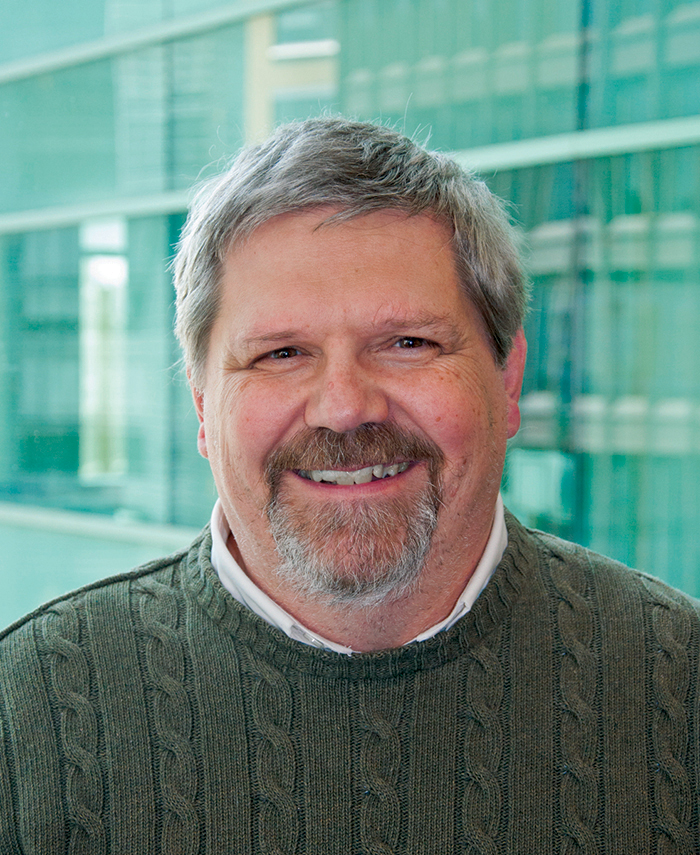
Statistics can be a force for good, but what does that look like in practice? In the second part of our statistics in service series, we interviewed David Corliss, who helps others through his daily work as a data scientist at Grafham Analytics, serves as a statistical expert witness, and represents the Council of Chapters on the American Statistical Association Board of Directors.
For the past several years, he has written the Amstat News column Stats 4 Good, where he shares ideas and offers tips for how statisticians can use their expertise to benefit our lives, our communities, and our world.
Corliss is a research scholar, a member of the Global Association of Human Trafficking Scholars, and an ASA Fellow. In 2014, he created the all-volunteer cooperative Peace-Work, where statisticians, data scientists, and researchers apply their knowledge to social justice, education, and poverty issues.
When did you first become involved in issue-driven advocacy, and what led you to create Peace-Work?
I first became involved in Data for Good early in my career as a data scientist. While I have always been active in public service work, I did not immediately make the connection to my work as a scientist. Then, after working in marketing analytics for several years, I received a request from a work colleague, whom I also knew through my volunteer work at Habitat for Humanity. I was asked to do a marketing study for the local Habitat for Humanity chapter to help recruit more donors and volunteers. I subsequently found out that nearly every charitable group has the same two questions, and I have repeated this study many times for different organizations. While I had volunteered for Habitat for Humanity for many years by helping to build houses, this project led me to realize I could have an even greater impact for these wonderful organizations and the good they do if the thing donated was my time as a scientist.
For the next 10 years, I worked on small independent projects—marketing studies, educational success and failure, risk factors for poverty and homelessness—and more. In the process, I met a number of people involved or wanting to get involved in similar work. In 2014, I founded Peace-Work as an all-volunteer collaborative of statisticians and scientists working on projects for the public good and now provide statistical support for charitable groups.
How does Peace-Work function in practice, and how can a statistician get involved?
Peace-Work has an unusual business model. There are so many wonderful groups working in this area! At Peace-Work, the concept that drives our operating model centers on data experts, statisticians, and data scientists volunteering a few hours a week in their spare time. All of us are doing community service in one way or another—volunteering at our children’s schools, working through community organizations, volunteering at an animal shelter—the possibilities are endless! The approach Peace-Work brings to the table is to make science the thing we donate to help and serve others in the community and around the world. Just imagine the power of hundreds of thousands of statisticians, data scientists, and data experts in the US alone donating two to four hours a week in a Data for Good project of their own choosing! Peace-Work exists to promote that concept of statistical volunteering, provide training and support, and help connect people with projects.
Can you share a project in which your analysis changed or improved a real-world situation?
A common way to support local charities and projects is providing support for grant proposals—documenting the need, analyzing recent changes, and demonstrating the effectiveness of an excellent organization. For the past few years, I have written grant proposals for a local food bank based in Blissfield, Michigan. When I started, the needs in the community were growing quickly, putting their ability to address it at risk. In the first year, they received a $10,000 grant from a local civic foundation. Grant proposals in subsequent years helped them expand the reach and impact of their program. This year, after four years of using data science to develop grant proposals, the food bank was in such a strong position financially that community grants were no longer needed to continue their mission.
I must say my great accomplishments are my students. I have been coaching students in science since I was a teenager, mostly in social work programs and those who are terrified of the required statistics classes. The work these students have done would fill many volumes! I have played only a small part , and yet, they still tell me today, a necessary one. Support for others learning statistical science to further their career in service to humanity is one of the most powerful things anyone can do in Data for Good!
For a student or early-career statistician who wants to volunteer their skills, where do they start and how much of a time commitment are we really talking about?
A key part of the Peace-Work model is volunteers who work with whatever time they have available. Projects are designed to be very brief or to handle interruptions from class, work requirements, and just everyday life. That’s the word play behind the name: Peace Work is what we do and Piece Work is how we do it, breaking up projects into small, bite-sized parts for volunteers with many demands on their time.
I’ve found the best way to get started is the same way I did: Begin with an organization where you already have a connection and relationship of trust—that really is the most important part—and then add science to the work you are doing already.
What do you wish more students understood about what statisticians can do outside academia or traditional research settings?
It’s easy to see the science inside of universities and research labs but it can be harder to see the science around us all the time, every day. Every business uses science to find customers and target their products and message. Every manufactured good we hold in our hands has scientists behind it optimizing its design and measuring its performance in the real world. Every community service organization needs science to understand the needs it is trying to address and make the most of limited resources to carry out its mission. It’s literally everywhere, all the time. Finding a Data for Good project starts with identifying a need or issue you want to address—because there are already a lot of people out there looking for you to help with their vitally important work.
Leave a Reply