
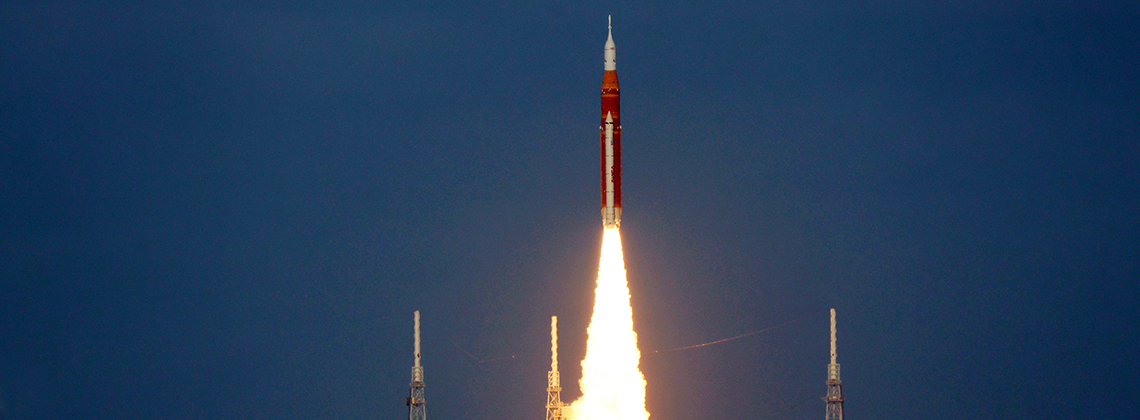
Artemis II takes off from NASA’s Kennedy Space Center in Florida on April 1 at 6:35 EDT. Photo courtesy of Adam Barone.
By Adam Barone

A native of Morocco, Amina Belkhayat Zoukkari and her father used to venture far from the city lights of Casablanca into the Atlas Mountains to look up at the stars and dream. Now a visiting research scholar at Embry-Riddle Aeronautical University in Florida, Zoukkari hopes to forge a career path in the aerospace industry that could lead to becoming the first Moroccan in space.
Statistics and data science, she says, are core elements of the skill set that will propel her there. She writes algorithms and uses Python to analyze massive data sets in her research on cryogenic fluid management in rocket engines.
“You have so much data, and any time you need to test several parameters at once, you can’t do that efficiently by hand or experimentation—that would cost so much in time and materials,” she said. “So, you do algorithmic iterations, and you may get an output of one or a few parameters, and then you only do experiments on those instead of hundreds and hundreds of possibilities. And now with AI, you can write your algorithm in an hour or less just by iterating through prompts until you get exactly what you want.”
Gazing upwards with a vision for their future is a common backstory among aerospace industry professionals. People genuinely inspired by the mysteries of the heavens come from disparate backgrounds to find their roles in the ongoing saga of humans in space. But without statistics and data science, nothing has ever left a launch pad. The problems to solve are only growing more numerous, complex, and nuanced as humanity pushes into full commercialization, militarization, and space exploration.
Why Aerospace for Statisticians and Data Scientists—Why Now?
To understand why demand is exploding for people with statistics and data science skill sets in aerospace, let’s start with a familiar statistical concept: cadence. In statistics, cadence is the rhythm or frequency at which data points are collected, observed, or events occur within a time series. In the aerospace realm, cadence also specifically refers to the tempo and volume of rocket launches.
In the last five years, SpaceX has increased its cadence from 31 total launches in 2021 to 165 launches of its Falcon 9 rocket in 2025. Projections for 2026 point to around 200 launches, and by 2030, between 400–600. When SpaceX’s Starship platform comes online, overall launch numbers will grow even larger. Meanwhile, competitors like Jeff Bezos’ Blue Origin totaled 13 launches in 2025, up from three in 2024. United Launch Alliance doubled its launch cadence from three to six in the last five years.
This matters because launch cadence is the foundation that unlocks every aspect of humanity’s potential in space—commercialization, militarization, and exploration. Greater cadence means greater capacity to carry infrastructure into space, which enables greater capability for space operations. Cadence and capacity correlate closely, but both depend on the other two Cs of the four Cs of space launch capability: confidence and cost.
“So, cadence, confidence, capacity, and cost—they’re all interrelated. Understanding that relationship is a good role for a statistician,” said Charles Galbreath, retired Space Force colonel, former deputy chief of the Space Force’s technology and innovation office, and current senior fellow at The Mitchell Institute for Aerospace Studies, a Washington, DC think tank focused on national security air and space power issues.
Several pathways exist for statisticians and data scientists to get involved in space operations.
Marshaling AI in Emerging Space Technologies
Data science and statistics are foundational to how AI enables space operations. Data science drives data collection, cleaning, structuring, and analysis that lead to operational insights. Statistics provides a framework for reasoning under uncertainty—probability, inference, error bounds, and model validation. AI then sits on top of that foundation with a human language interface that provides decision support for human operators.
Anyone responsible for employing AI in high-consequence environments must understand the principles and fundamentals of how these systems work—particularly their assumptions, limitations, and uncertainty,” said Thomas “Steamer” Ste. Marie, a retired US Air Force colonel who spent his career in national security space operations and now works as a consultant in private aerospace. “The greatest danger is not uncertainty. We routinely operate with uncertainty. The greatest danger is false confidence. Leaders risk treating recommendations as if they were facts if they cannot clearly interpret and articulate model confidence, data quality, bias, or error bounds.”
Statistics provides a framework for reasoning under uncertainty—probability, inference, error bounds, and model validation. AI then sits on top of that foundation with a human language interface that provides decision support for human operators.
Another context in which statisticians and data scientists work with AI to make an impact in space is procurement.AI is an important tool for evaluating procurement data, offering improvements in efficiency and determining balanced spending distributions. For example, NASA recently conducted a successful test integrating AI into its proposal evaluation processes, cutting a process that used to take three months down to just weeks. For statisticians, this points to potential careers in procurement analytics, where roles might involve organizing data to inform spending decisions, track distributions, and support AI integration.
Quality Assurance and Compliance
Ensuring the safety, reliability, and regulatory adherence of spacecraft and components—where even minor defects can lead to catastrophic failures—is critical for all types of space operations.
Statistics and data science play a crucial role in designing systems to monitor processes, predict defects, and ensure compliance with quality standards such as AS9100, FAA regulations, and ISO 9001. These internationally recognized frameworks help organizations ensure consistent product and service quality, safety, reliability, regulatory compliance, and customer satisfaction. They provide a systematic approach to managing processes; reducing risks; minimizing defects; and driving continuous improvement across design, manufacturing, supply chain, and operations.
In QA contexts, statistical process control techniques such as control charts and capability analysis detect variations in manufacturing, enabling early intervention when issues arise. In compliance, statisticians and data scientists develop predictive models using machine learning algorithms to forecast risks in supply chains or audit outcomes.
BPR Hub, based in Fort Worth, Texas, makes a compliance and quality management software platform for aerospace firms. The platform relies heavily on statistical thinking and data science to enhance vendor management, performance tracking, and risk mitigation. It helps aerospace companies improve efficiency, ensure compliance, and make data-informed decisions for safety-critical operations, integrating real-world auditing insights and practices to support customers in improving resource allocation, cost control, and overall operations.
“It’s not just about capturing data, it’s about using it and understanding it,” said Mark Hahn, vice president of sales for BPR Hub. “Smaller aerospace companies especially don’t have statistical and data science capabilities in-house. Sometimes they don’t look at that stuff at all. They don’t realize how much better they can become by applying statistics and data science to their business. So, there’s a big role for people with those skills in product development and, potentially, in consulting with customers.”
Military: Awareness, Security, and Operations
Statistics and data science play a critical role in monitoring, understanding, and managing military activities in space, enabling analysis of vast data sets to detect patterns, assess risks, and inform decision-making.
For example, statisticians and data scientists may process sensor data from satellites, radars, and ground stations to track objects, predict threats, and maintain situational understanding. This work quantifies probabilities of collisions or adversarial maneuvers, giving commanders the intelligence they need to allocate resources effectively and mitigate risks.
Statistics and data science play a critical role in monitoring, understanding, and managing military activities in space, enabling analysis of vast data sets to detect patterns, assess risks, and inform decision-making.
“In space security operations, you rarely have perfect information,” Ste. Marie said. “Instead, you infer behavior and risk from streams of imperfect observations: telemetry; orbital tracking data; maneuver histories; sensor inputs; and contextual intelligence. Statistics and data science turn that incomplete picture into actionable assessments.”
For example, simulations analyze orbital paths. More broadly, Monte Carlo methods aid in assessing proposed system or architecture improvements. Other data science methodologies facilitate anomaly detection and fusion of information from disparate sources for real-time insights.
“You’re assessing the likelihood of an event happening and then the consequences of that event,” Galbreath said, emphasizing statistics’ practical application in evaluating space architectures and risks. “Let’s run through multiple simulations and do a Monte Carlo assessment to determine how much better it is if we have this number of assets or place them here.”
Galbreath also touched on survey data analysis, where descriptive statistics interpret variability in sensor readings or performance metrics. “In analyzing survey data, where was the high, where was the low, where was the median? What’s that deviation?”
Data and Statistical Thinking in NASA Partnerships and Capabilities
The NASA Data Science Group is an interdisciplinary collaborative of thousands of scientists from NASA and the private sector conducting research and building tools and methods to solve problems in machine learning and knowledge discovery. It advances NASA’s missions by helping space operators understand and assimilate scientific and engineering data. The group offers access to facilities for managing petabytes of Earth science data such as satellite observations and climate records. Successful collaborations have occurred in additive manufacturing, lunar lander development, and on-orbit servicing.
“Goddard Space Flight Center hosts the Earth Observing Systems Data Information Systems, and that’s data-as-a-service available to decision-makers and industry to accelerate and mature technologies,” said Brandy Quam, formerly of NASA and current senior vice president of air domain at Perrarus Solutions.
These partnerships allow small and large companies to access world-class capabilities without massive capital investments, accelerating technology development and reducing costs.
Opportunities also abound in algorithm development and validation, anomaly detection, quality assurance, uncertainty quantification, error propagation, data fusion, and multi-sensor integration. There are also opportunities in developing decision support tools, performance benchmarking, and process optimization.
You’ve Got What It Takes
It may be a surprise to learn the US Space Force accepts recruits up to age 42. Certainly, that’s one avenue a data scientist or statistician could take to enter aerospace. However one approaches this industry, being proactive and adaptable is key. Build visibility to the industry through networking at aerospace events. Invest in your development, which might include learning aerospace-relevant tools or positioning yourself as a bridge between technical analysis and mission success.
One thing is certain: Data-intensive operations and increasing mission complexities are creating a significant and growing talent gap in aerospace for technically versatile people who can handle complex data sets, modeling, and decision-support tasks.
Back at Embry-Riddle, Zoukkari knows she’s one of those people. Her research fellowship concludes this summer, after which she’ll return to Morocco to complete her master’s in mechanical design and numeric simulation. Then, a PhD program—hopefully back in the US, she says. Until then, she’ll continue using her skills in statistics and data science to improve how cryogenic fluid flows between tanks in rockets—an especially prescient challenge given how similar issues delayed the Artemis II mission.
Key Tools for Statisticians and Data Scientists in Aerospace
Core Programming
Python: The dominant language in modern aerospace data work (NASA, SpaceX, ESA, etc.). Must-have libraries: NumPy, Pandas, SciPy, Matplotlib/Seaborn, Scikit-learn.
Monte Carlo Simulation
- STK (Systems Tool Kit) by AGI – Industry standard for orbit visualization, coverage analysis, and Monte Carlo risk assessment (common at NASA, SpaceX, DoD).
- GMAT (General Mission Analysis Tool) – NASA open-source trajectory design and optimization software.
Reliability & Risk Analysis
- ReliaSoft or R packages (lifecon, reliaR) for reliability engineering and failure rate modeling.
- OpenTURNS (Python/C++) – Uncertainty quantification and sensitivity analysis (used in French aerospace and increasingly elsewhere).
Geospatial & Orbital Data

Adam Barone
ASA Senior Editor (Contract)
Leave a Reply